
What Smart Health Summit 2026 Showed About Healthcare AI
Last reviewed: September 2026 · 9 min read
Ireland spent three years writing its digital health strategy. On 15 September 2026, at Croke Park in Dublin, the Business Post Smart Health Summit opened its doors to the people who now have to deliver it:
By the time the summit opened, the policy work was largely done. Ireland's first national AI strategy for healthcare had been published in March, and the interesting question had shifted from what the health service intends to do to what it can make work in a safe, controlled manner. This piece covers why 2026 was the year that shift happened, who sat on the closing AI panel and why the mix of them mattered, the four things that decide whether a clinical AI project survives deployment, and what all of it means for how doctors are trained. For the wider picture of where AI sits across medical training, our guide to AI in medical education covers the full landscape.
Why was 2026 a pivotal year for Irish digital health?
2026 was the year Irish healthcare ran out of reasons to discuss AI in the abstract. The policy scaffolding is now built. Digital for Care, the national digital health framework for 2024 to 2030, set the direction. In March 2026 the Department of Health published AI for Care, Ireland's first national AI strategy for healthcare, covering 2026 to 2030.
The funding moved with it. The HSE Digital for Care Capital Plan 2026 allocated €263 million to digital health for the year, supporting the National Electronic Health Record, the HSE Health App and related infrastructure. Health digitalisation also sits among the priority areas within the €9.25 billion National Development Plan provision for the health sector across 2026 to 2030, a figure that funds buildings and equipment alongside digital work rather than digital alone.
So strategy was no longer the constraint, and neither was money. Delivery was. That's what gave the summit its particular tension this year, and it's why the closing session was the one worth staying in the room for.
Who was on the AI panel, and why did the mix matter?
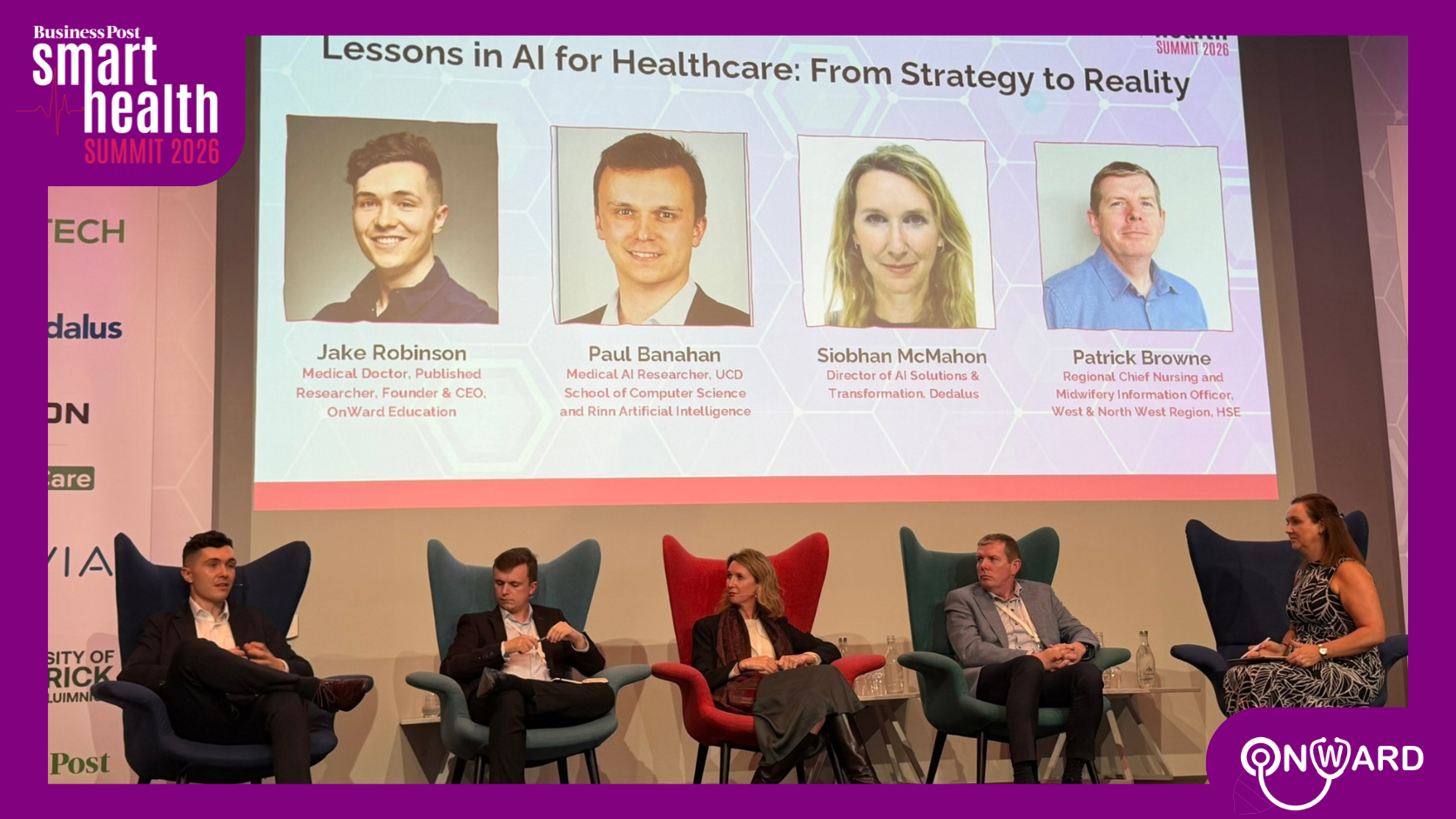
Watch the highlights from the “Lessons in AI for Healthcare: From Strategy to Reality” panel at Smart Health Summit 2026.
The programme closed with a panel titled "Lessons in AI for Healthcare: From Strategy to Reality". It put four deliberately different vantage points on the same stage. Paul Banahan joined as a Medical AI Researcher from the UCD School of Computer Science and Rinn Artificial Intelligence. Siobhan McMahon is Director of AI Solutions and Transformation at Dedalus. Patrick Browne is Regional Chief Nursing and Midwifery Information Officer for the West and North West Region of the HSE. Dr Jake Robinson is Founder and CEO of OnWard Education.
Academic research, a health technology vendor, the health service itself, and medical education. The composition was the substance of the session, because each of those four seats sees a different part of the same failure, and none can describe the whole alone.
A researcher sees a model that performs well on a held-out test set. A vendor sees a deployment that stalls in procurement or integration. A regional nursing information officer sees what happens when a tool reaches staff who were never consulted about it. Someone working in clinical education sees learners forming habits around these systems years before they qualify. Put those four views in sequence, and you get something closer to the real shape of the current situation.
Where does healthcare AI actually break down?
A strategy document sets direction. It can't make a tool survive a Tuesday morning on a busy ward. Four things tend to decide whether a healthcare AI project becomes routine practice or a well-reviewed pilot that quietly stops.
Workflow fit beats model quality. Clinicians don't have spare cognitive capacity to give a new system. A tool that needs a second login, a separate screen, or a change to how a team already documents its work will lose, however good the model underneath it is. The question is rarely whether the technology can perform the task. It is whether it can perform it inside the workflow that already exists.
Data quality sets the ceiling. Most clinical data was recorded to deliver care, not to train or evaluate a model. It's inconsistent, incomplete in patterned ways, and structured for a purpose other than analysis, let alone the fact most of it is still handwritten. That caps what any system built on it can do reliably, and it is not a problem you can solve at the model layer.
Trust is earned, not assumed. Staff need to understand what a tool is doing and why before they will rely on it in front of a patient. Explainability is not a compliance checkbox in this setting: it's the mechanism by which a tool becomes usable at all. This is where the distinction between complementing a clinician and replacing one stops being a positioning line and becomes a design requirement.
Governance has to move at the speed of capability. Capability is advancing faster than the assurance processes around it. Where governance lags, safe and useful projects stall next to the ones that should stall. Where it's absent, risk accumulates quietly instead. Neither outcome serves patients, and closing that gap is an organisational job rather than a technical one.
What does this mean for how doctors are trained?
These four constraints are usually discussed in terms of patient care. They apply just as directly to clinical education, which carries an additional weight: it shapes how a generation of doctors learns to work alongside these systems before any of them carries clinical responsibility for the output.
Clinical education runs on scarce expert attention. A consultant moving through a list of ten or fifteen patients optimises for patient safety and throughput, not for a structured teaching moment, so the feedback a student receives is shaped by whatever time is left over that week. Signs that someone is struggling often surface late, once enough evidence has accumulated to be unmissable. That's a structural reality of the systems Irish and UK students train in, not a failure of individual consultants and registrars.
It's also a data and workflow problem before it's an AI problem, which makes clinical training a useful test of everything above. An assessment tool that returns a score an educator cannot interrogate will not be used and should not be. One that makes patterns visible, shows its working, and leaves the judgement with the educator has a chance of changing something. The same requirement that governs a diagnostic tool on a ward governs a scoring tool in a training environment: a human has to be able to see why it said what it said. Our guide to building clinical reasoning skills goes deeper on the skill itself, and AI ethics in medical education covers the boundaries students are navigating while they learn it.
Better supported educators and better prepared doctors are a patient safety outcome, not only an academic one. That's the argument for treating clinical education as part of Ireland's digital health agenda rather than a footnote to it.
OnWard: AI-scored case presentation practice, built for HSE wards
OnWard Education gives medical students structured, repeatable practice at presenting real-patient cases during clinical placements, then scores that practice against frameworks written by clinicians rather than generated by an AI. The case library covers 100+ common adult-medicine conditions, and a human stays in the loop on what counts as sound reasoning for each one, which answers the two objections Irish medical schools raise most often about AI tools: hallucination and academic integrity.
Students present cases through the app and get instant, objective feedback. A digital logbook tracks every attempt, and the Educator Portal gives medical schools cohort-level data for programme assessment without adding to faculty workload. OnWard is backed by Enterprise Ireland and the Learnovate Centre at Trinity College Dublin.
Individual student access is €14.99 per month or €149.99 per year. Medical school cohort licensing is available on request.
Key takeaways
Ireland's digital health conversation has moved past direction-setting. With AI for Care published and capital allocated, 2026 turned the question into one of delivery and accountability.
The barriers to clinical AI adoption are mostly organisational, not technical. Workflow fit, data quality, clinician trust and governance decide outcomes more often than model performance does.
Explainability is a usability requirement, not a compliance formality. Staff will not rely on a tool they cannot interrogate, and they should not be asked to.
Clinical education belongs in the same conversation as clinical care. The tools trainees learn alongside shape their practice long before they qualify.
Mixed panels beat single-perspective ones. Research, vendors, health services and education each see a different part of the same problem, and the overlap is where the useful conclusions sit.
Frequently asked questions
When and where was Smart Health Summit 2026 held? Smart Health Summit 2026 took place on 15 September 2026 at Croke Park, Dublin. The Business Post runs the summit as an annual forum for digital health leadership in Ireland, structured around panels and parallel sessions rather than formal presentations.
What was the "Lessons in AI for Healthcare" panel about? It examined what happens after a national AI strategy is published. The session asked whether AI can be implemented across the health service safely, in a way that earns the trust of staff and patients, integrates into existing workflows, and delivers measurable value rather than a pilot-stage promise.
Who spoke on the AI panel? The panel featured Paul Banahan of the UCD School of Computer Science and Rinn Artificial Intelligence, Siobhan McMahon of Dedalus, Patrick Browne of the HSE West and North West Region, and Dr Jake Robinson of OnWard Education. The full agenda is published at smarthealthsummit.ie.
What is Ireland's AI for Care Strategy? AI for Care is Ireland's first national artificial intelligence strategy for healthcare, published by the Department of Health in March 2026 and covering the period to 2030. It sits alongside Digital for Care, the wider digital health framework for 2024 to 2030.
How much has Ireland committed to digital health? The HSE Digital for Care Capital Plan 2026 allocated €263 million to digital health for 2026, covering the National Electronic Health Record, the HSE Health App and related infrastructure. Digital health is also one of the priority areas inside the €9.25 billion National Development Plan provision for the health sector from 2026 to 2030, which funds buildings and equipment as well.
Why does AI in medical education matter to the health service? Because clinical training shapes practice. Students who learn to use AI tools critically, checking output against reasoning they have already done themselves, carry that habit into clinical work. The requirements that determine whether AI succeeds on a ward apply just as much in a training environment.