
AI in Medical Education: A Guide for Irish Medical Students
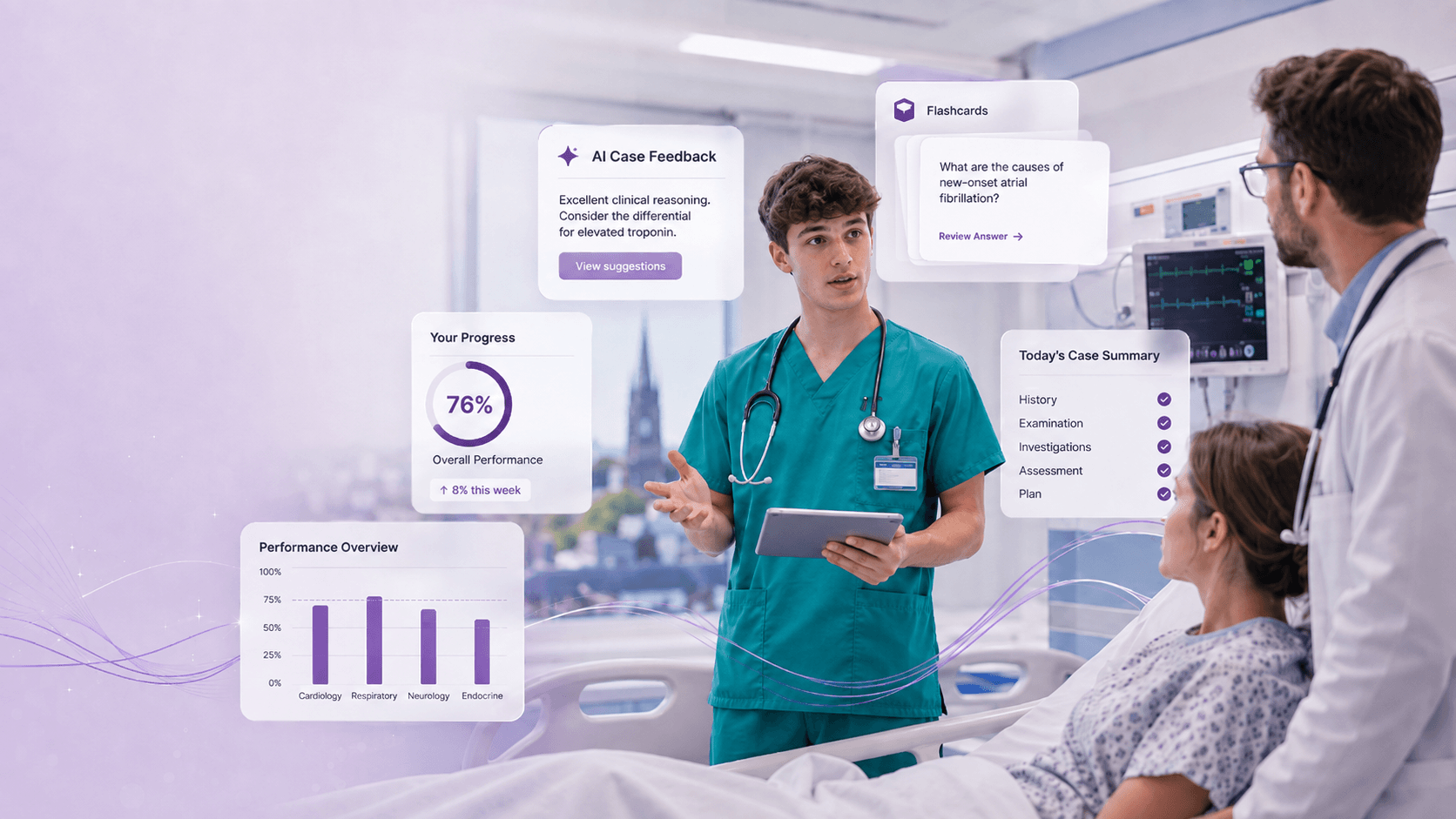
Most clinical students in Ireland describe the same experience. You clerk a patient, take a detailed history and physical exam, and finally present your case to a senior doctor on a ward round. The team moves on in under two minutes, and you have no idea whether your differential was reasonable or your presentation clear enough for a weary registrar. This scenario happens almost daily - yet much of that work leaves no trace. The histories you take, cases you present, feedback you receive and progress you make are rarely captured in any structured way. By the end of a rotation, dozens of meaningful clinical encounters can amount to little more than a signature in a logbook.
It is in these encounters we do most of our learning however, and AI tools are starting to close part of this gap: what they do, how they hold up under scrutiny, and how to use them without compromising your development or your patients.
What is AI in medical education?
AI in medical education means applying machine learning, natural language processing and adaptive algorithms to how medical students learn and get assessed: This can take many forms, from automated feedback on case presentations, adaptive flashcards, virtual patient simulations, clinical reasoning practise and cohort analytics for medical schools.
The term hides a lot of variation. A question bank that resurfaces your weak topics is using AI. A platform that scores your oral case presentation is using AI. That virtual patient you clerked is using AI. A chatbot that explains pharmacology is using AI. While the underlying technology may often be similar; what it's actually used for is not, and that distinction matters more than the AI label does.
How is AI currently used in medical education?
Three areas account for most of what clinical students will actually encounter.
Formative Feedback
Some platforms score oral case presentations and history-taking attempts against structured clinical frameworks, producing objective, consistent feedback without needing a senior clinician in the room. In busy HSE teaching hospitals, that clinician is managing patient flow, admin, and rota pressure that leaves little space for structured student teaching. The feedback gap is a structural reality of the systems UK and Irish students train inl, not a failure of individual consultants and registrars, who are stretched thin for reasons that have nothing to do with teaching.
Assessment Preparation
Generating MCQs, OSCE scenarios, clinical scripts, flashcards and practise questions. AI is also increasingly being investigated for automated assessment and scoring.
Personalised Tutoring and Explanation
Students ask LLMs to explain difficult concepts, answer questions, summarise material and adapt explanations to their level. This is one of the dominant uses of generative AI.
Simulated Patients
Conversational AI can act as a patient so students can practice history taking, communication and clinical decision-making. Emerging systems combine the simulated encounter with automated assessment and feedback.
Adaptive Learning and Spaced Repetition
AI-powered flashcard platforms, like Anki, adjust which cards appear based on your previous answers, timing review for the point where recall is about to fail rather than on a fixed schedule. It's also the area students most often assume is interchangeable with structured case practise, which it isn't; see AI flashcards vs traditional flashcards for where the two actually diverge.
How is AI used in healthcare more broadly?
Medical education is one slice of a much bigger shift. AI in healthcare goes far beyond what a student uses directly.
Radiology departments, like in the Mater Hospital, use AI image analysis to triage scans and flag abnormalities for a specialist to review; the AI doesn't - it prioritises which scans for a human to report. Hospital management use predictive analytics to forecast bed occupancy, and a growing number of
Many physicians are now using ambient documentation tools that draft the clinical note during a consultation, such as Heidi. Pharmaceutical research uses AI to narrow which drug candidates are worth testing first, compressing a process that used to take years of trial and error.
AI is a tool, not a replacement for clinical judgement. The same should be true in medical education. AI can support learning with immediate feedback, but the student still has to walk the wards, see the patients, present the cases and do the thinking. Years later, the principle is no different when they are using decision support at 3am on a night shift.
Can AI improve clinical reasoning?
Clinical reasoning is the core skill of clinical medicine and one of the hardest to teach directly; it involves gathering information, forming a hypothesis, testing it, and reaching a diagnosis. You build this skill by doing it, even badly at first, with someone pointing out where your logic breaks down.
No AI tool replaces genuine clinical experience with real patients under qualified supervision. Pattern recognition and clinical instinct come from real patients. AI tools provide structured practise; they don't provide clinical experience, and treating the two as interchangeable is where students get into trouble.
AI offers a new way to provide some of that practise. Case-based simulations can let students work through clinical problems repeatedly, while AI feedback tools can assess their reasoning, challenge a differential and identify gaps they may have missed.
It is well established that deliberate, structured practise consistently improves performance, though exactly how much AI-mediated practise adds on top of traditional bedside teaching is still a developing research area.
For now, the evidence supports AI as an adjunct to learning, not a replacement for established methods. Our full breakdown is in AI and clinical reasoning for medical students.
Clinical reasoning gets formally assessed during the intern year through workplace-based assessment, with the Medical Council awarding a Certificate of Experience at the end of a satisfactory year. The clinical years pay off most during medical school practise, before you're expected to demonstrate it unsupervised as an intern.
Can AI help with case presentation practice?
Yes, and this is arguably the clearest educational application of AI in clinical medicine for students in Ireland specifically.
A well-structured presentation follows a recognised format: presenting complaint, history, past medical and drug history, examination findings, investigations, assessment and plan.
Presenting competently requires repetition that most students never get, because ward rounds move quickly and the senior clinicians who could provide feedback are busy with everything else on their list.
AI tools that let a student present a case, get structured scoring, and repeat the process independently solve a real bottleneck. This is the gap OnWard Education was built to close: students present cases through the app and get instant, objective scoring against clinician-authored frameworks covering 100+ common adult-medicine conditions, written by doctors, not generated by AI. The feedback reflects real clinical expectations rather than an AI's approximation of them.
Can AI help students prepare for OSCEs?
Finals OSCEs typically run across 15 to 20 stations of seven to ten minutes each, assessed by trained examiners against standardised mark sheets, covering history-taking, examination, communication and clinical reasoning. The format is broadly consistent across RCSI, UCD, Trinity, UCC and Galway, though the exact station mix varies.
The stakes are real: a poor OSCE station can affect your final grades and class ranking, and ultimately influence whether you get the intern post you want or find yourself moving across the country.
This isn't an exam where partial preparation is good enough.
Benefits of AI in medical education
AI tools support OSCE preparation in three ways:
Simulated patients let you practice history-taking and receive structured feedback, LLMs like ChatGPT can help with clinical knowledge and adaptive flashcards can even target the specific areas of weakness.
What none of them do is replicate a real station: the physical exam, the time pressure, and reading an examiner's face.
AI needs to work alongside that real preparation, that only comes from seeing patients on the ward.
Our guide to using AI for OSCE preparation breaks this down station by station. (new blog on this coming soon!)
What are the risks and limitations?
This area is the section AI platform marketing tends to skip past.
Hallucinations and inaccurate content.
Every large language model generates plausible-sounding content that can be factually wrong. A hallucinated drug dose or incorrect diagnostic criterion is a patient safety risk if you carry it into practise without checking it. What matters is where the content comes from: content generated on demand by an AI carries hallucination risk by design; content authored by clinicians and stored as fixed knowledge carries substantially less. Check the sourcing before you trust a tool aimed at medical students.
Data privacy and your HSE obligations.
Confidentiality and data-handling obligations apply from day one of a clinical placement and don't pause when you open an app between ward rounds. GDPR, enforced by the Data Protection Commission, governs how patient data can be used, and HSE and universities layer their policies on top. Use fictional or de-identified patient details for any AI practise. Never paste real clinical notes, patient names or other identifying information into any AI tool, including ChatGPT or Gemini. A data breach through an AI app carries the same consequences as any other.
Academic integrity.
Using AI to write reflective portfolio entries or complete assessed submissions can breach both university regulations and your obligation to be honest under the Medical Council's guidance.
Our guide to AI ethics in medical education covers the grey areas. (will be linked here soon - stay tuned!)
Over-reliance
The biggest long-term risk is reaching for an AI tool before you've formed your differential or have your own knowledge base. Treat AI as a practice partner, not an answer bank: form your own differential first, then check it against the scoring. The value sits in the comparison, not in reading the framework before you've thought it through yourself.
The role of educators and clinical supervisor
AI tools don't replace qualified clinical supervision with real patients, official curricula, current guidelines from the Medical Council and the National Clinical Effectiveness Committee, or professional medical judgement in patient care. The ward round teaches things no platform reproduces: reading a patient's body language, communicating as a doctor, managing uncertainty at a bedside, and absorbing a senior physician clinical instinct in real time. What AI provides is a scale that the HSE simply can't achieve with its staffing. It's a supplement, not a substitute.
Nor does AI replace medical educators. What changes is where teaching time goes: if AI handles structured, repetitive practice at scale, an educator's time shifts toward mentorship and complex reasoning discussions instead. The real risk is that AI is deployed as a cost-cutting substitute for teaching, rather than as a way to free up a teacher's time; this is an institutional decision, not a technology problem.
Is it ethical for medical students to use AI?
Yes, with conditions. The Irish Medical Council's Guide to Professional Conduct and Ethics sets standards around honesty, patient confidentiality and maintaining competence, with direct implications for how you use AI tools. The Medical Council's guidance for medical schools on student conduct extends the same principles specifically to students. Neither prohibits AI learning tools outright. A clinician-built tool for structured practice sits comfortably within those standards; a general-purpose chatbot writing your portfolio reflections does not.
OnWard: AI-scored case presentation practice, built for HSE wards
OnWard Education was built by Dr Jake Robinson, a graduate of the Royal College of Surgeons in Ireland who has stood on HSE wards himself: the speed, the competing demands, and the way structured feedback for students is deprioritised, not because nobody cares, but because nobody has the capacity. He built OnWard to close a gap that most Irish clinical students recognise as soon as they describe it.
The platform was built for HSE wards from the outset, not adapted from a US tool after the fact. The clinical cases and scoring frameworks reflect the standards you actually work to. The case library, 100+ common adult-medicine conditions, is authored by clinicians, not generated by AI, which answers the two objections Irish medical schools raise most often. The focus is on AI tools, specifically hallucination and academic integrity. OnWard is backed by Enterprise Ireland and the Learnovate Centre at Trinity College Dublin.
Students present cases through the app and get instant, objective scoring and feedback. A digital logbook tracks every case and flashcard attempt. OnWard Insights dashboards show performance by speciality and over the course of a placement. The Educator Portal provides medical schools with the cohort data they need for programme assessment, without adding to faculty workload.
Individual student access is €14.99 per month or €149.99 per year. Medical school cohort licensing is available on request.
How should medical students use AI responsibly?
Use AI for practice, not for answers. Form your differential first, then compare it to the AI feedback. Reading the answer first defeats the purpose entirely.
Never input real patient information. From day one on an HSE placement, GDPR and HSE data standards bind you as strictly as any other staff member who handles patient data.
Check your institution's AI policy before using any tool for assessed work. The rules at UCD aren't necessarily the rules at RCSI, Trinity, UCC or Galway. Ask your academic administration team directly rather than assuming other students using a tool means it's sanctioned.
Stay in control of your reasoning. AI tools should build your clinical independence over time, not erode it. If you can't present a case without an AI prompt in front of you, that's a warning sign.
Key takeaways
AI in medical education covers tools with genuinely different purposes; match the tool to the specific gap in your learning.
Case presentation practice and clinical reasoning simulation are the clearest applications for clinical students in Ireland.
Clinical placements matter beyond finals in both systems. Foundation Programme assessments and the Intern Match both reflect the clinical development your training years are meant to build.
Your HSE data obligations apply to every AI tool, without exception. Never input real patient information into any platform.
AI-assisted practice is appropriate. AI-generated submitted work or reflections are not appropriate.
Frequently asked questions
What is AI in medical education? The application of machine learning and adaptive algorithms to how medical students learn and get assessed, from adaptive flashcards to automated case presentation scoring and cohort analytics for medical schools.
How can AI be used in healthcare? Beyond education, AI supports clinical decision support, diagnostic imaging triage, predictive analytics for bed capacity, ambient documentation, and drug discovery research, handling pattern recognition and administrative load at scale while a clinician makes the final call.
Can AI improve clinical reasoning? It creates more structured, frequent opportunities to practise, which is a genuine benefit given how limited supervised practise is on ward placements. Whether it beats traditional teaching alone is still being studied, but structured, feedback-rich practise reliably improves performance.
What are the risks of using AI in medical training? The risks include hallucinated content, data privacy breaches, academic integrity violations if AI-generated work is submitted as your own, and overreliance that erodes independent reasoning. Risks are highest in tools that generate content rather than using clinician-authored material.
Is it ethical for medical students to use AI? Yes, with conditions. A clinician-authored tool for structured practise is ethically sound; general-purpose AI generating submitted work is not. The governing framework in Ireland is the Irish Medical Council's Guide to Professional Conduct and Ethics.