
AI Ethics in Medical Education: A Guide for Irish Students
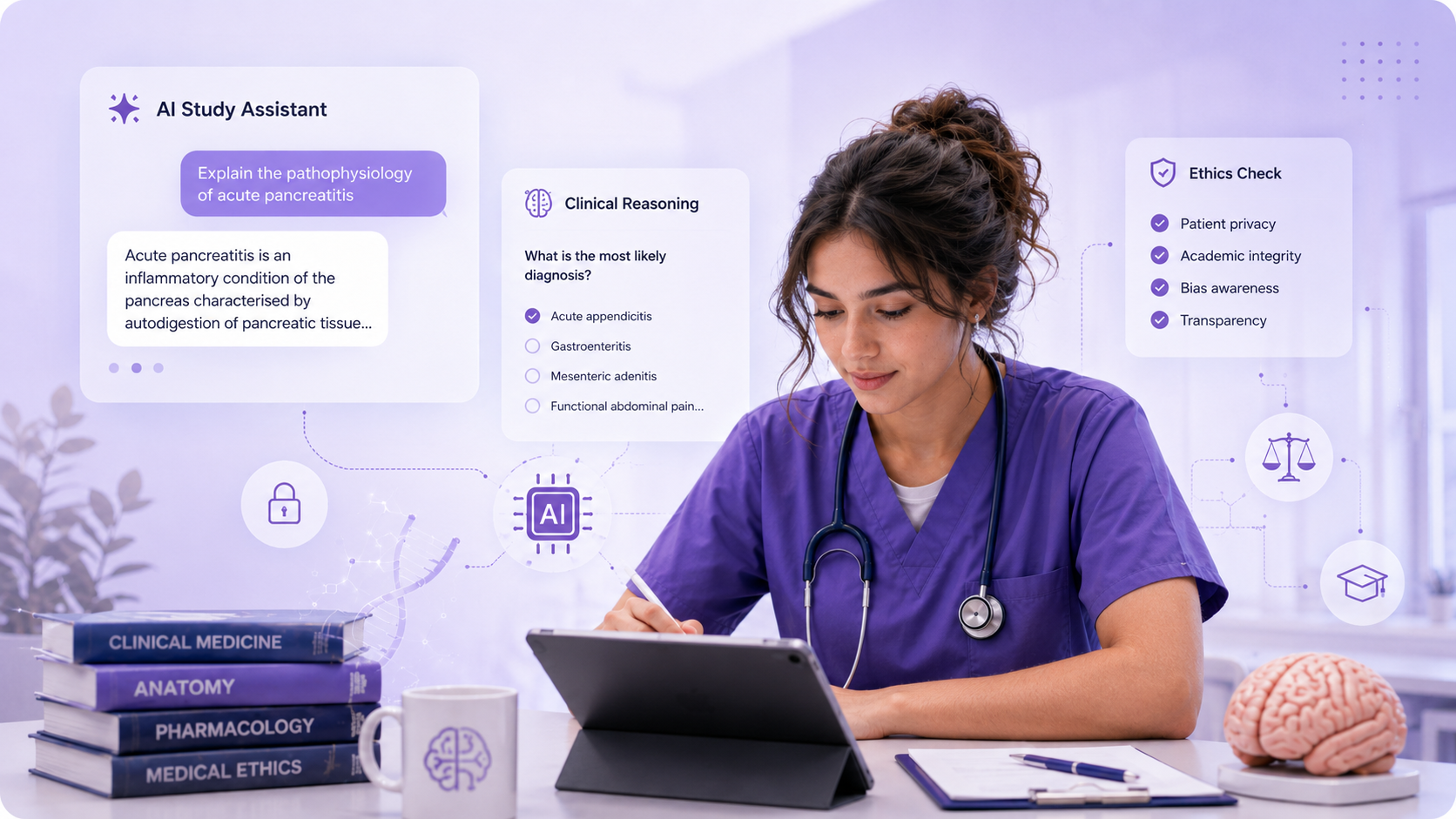
It's eleven at night, the reflective portfolio entry is due tomorrow morning, and the cursor has been blinking on an empty page for twenty minutes. ChatGPT would get this reflection on that patient done in thirty seconds. Nobody would know…
That moment, not a lecture on research ethics, is where most Irish medical students actually meet the question of AI ethics for the first time. The IrishThe rules aren't always obvious, and the grey area is changing as AI becomes a bigger part of our lives. Some AI use is a genuine, sanctioned part of modern clinical training. Some cross into territory that can end a career before it starts. This guide sets out where those lines actually sit: academic integrity, patient data, the risk of acting on a hallucinated answer, and what happens to your clinical judgement if you lean on AI too early and too often.
How do the four pillars of medical ethics apply to AI in medical education?
The traditional four pillars of medical ethics provide a useful framework for considering how AI should be used by medical students: autonomy, beneficence, non-maleficence and justice.
Autonomy means respecting a patient’s right to make informed decisions about their care. Medical students using AI must remember that learning with new technology should never compromise patient choice, confidentiality or the patient’s role in decisions about their care.
Beneficence means acting in the patient’s best interests. AI can support medical education through personalised learning, feedback and opportunities to practise clinical reasoning. The ultimate purpose, however, should be to develop more competent clinicians and improve future patient care.
Non-maleficence, or “do no harm”, is particularly important when students use AI for clinical learning. Inaccurate or hallucinated information can be mistaken for fact, while inappropriate use of real patient information can compromise confidentiality. AI-generated clinical content should therefore be critically assessed and verified.
Justice is reflected by ensuring that AI does not create or worsen inequalities in medical education. Differences in access to paid AI tools may disadvantage some students, while biases within AI systems can lead to certain patient populations being poorly represented in educational content.
For medical students, the question is therefore not simply whether AI should be used, but whether it is being used in a way that respects patients, improves learning, avoids harm and remains fair.
Is it OK to use AI for medical school assignments and reflections?
It depends entirely on what the assignment is testing. Using AI to explain a concept you're struggling with, generate practice questions, or restructure your notes is generally fine and widely accepted. Using it to write the reflective entry itself, which is meant to demonstrate your insight into a patient encounter, is not acceptable, because the entire point of that assignment is that the insight is yours.
RCSI's Generative AI Usage Policy, launched in April 2026, sets out five foundational principles for how staff and students at the college should use AI: accountability, transparency, respect and equity, data protection and cybersecurity, and integrity in teaching, learning and research. The policy doesn't ban AI, but it does require a human in the loop. Any AI involvement in academic work must be acknowledged and documented, and a suitably informed person, not the AI, remains responsible for reviewing, validating and acting on whatever it produces. That's the practical test worth applying to your own work: could you acknowledge exactly how you used AI on this piece of work, in writing, without it undermining the mark you'd get for it? If the honest answer is no, don't submit it.
The distinction that actually matters isn't AI versus no AI: it's how and what that tool is used for. Practising with AI feedback on your own time is a different act from submitting AI-generated reflection as evidence of your own professional development.
Can I put patient information into an AI tool?
No, you must not enter real patient information into any AI tool, including well-known ones like ChatGPT or Gemini. This is one of the few areas where the ethical position and the data-protection position point in the same direction.
GDPR, enforced in Ireland by the Data Protection Commission, governs how patient data can be processed, and your confidentiality obligations as a clinical student apply from your first day on an HSE placement, not from the day you graduate. Feeding a real patient's history, even a few identifying details, into a general-purpose AI tool means that data leaves your control the moment you hit send. You don't know where it's stored, whether it's used to train the model, or who else might see it. A data breach caused by pasting a case into an AI app carries the same professional consequences as any other breach of patient confidentiality.
The practical fix costs nothing: use fictional or fully de-identified details for any AI practice. This includes the age, initials, exact dates, and specific ward. If a case is distinctive enough that someone on your team would recognise the real patient from your altered version, it is still not de-identified.
What's the ethical risk of AI hallucinations?
The risk is that a plausible-sounding wrong answer gets treated as a right one, and the harm shows up in a patient rather than in your grade. Every large language model can generate a confident, well-formatted, entirely wrong drug dose or diagnostic threshold. Nothing about the tone of the answer tells you it's wrong.
The ethical obligation this creates is straightforward, even if it's inconvenient: you check AI-generated clinical content against a source you trust before you rely on it every time, with no exceptions for content that looks especially polished. This is where the source of the content matters more than the AI label. A tool that generates explanations on demand carries hallucination risk by design. A tool built on clinician-authored, fixed content carries a different and much smaller kind of risk: the underlying material is physician authored and reviewed, and nothing is being invented at the point you read it. Knowing which kind of tool you're using is itself part of using AI ethically.
Is AI fair to every student?
Not automatically, and this is where the justice principle above gets the least attention, despite being explicitly named in RCSI's own AI principles under respect and equity. Premium AI tools cost money. Some students have laptops and connections that make heavy AI use easy. Others don't, and a curriculum or an informal culture that assumes everyone has equal access to the same tools can quietly widen gaps that have nothing to do with clinical ability.
There's a second, less visible equity question too: AI models are trained on data that skews toward the conditions, presentations and patient populations best represented in existing medical literature, which is not evenly distributed across ethnicities, sexes or healthcare systems. A student leaning on AI explanations without also seeing a wide range of real patients risks absorbing those same gaps as blind spots they won't notice until they matter.
What do the regulators and medical schools say?
Neither the Irish Medical Council nor RCSI prohibits AI learning tools outright, and neither treats the question as fully settled. Universities and medical schools may each set their policies on generative AI, so RCSI's approach, while a useful example, isn't necessarily identical to every institution's.
The Irish Medical Council's Guide to Professional Conduct and Ethics sets the standards around honesty, patient confidentiality and maintaining competence that apply to how you use AI, both as a student and later as a doctor. The Medical Council's guidance for medical schools on student conduct extends the same principles specifically to students. RCSI's 2026 GenAI Usage Policy applies the same underlying values specifically to coursework and research and adds a practical requirement: AI use in academic work has to be acknowledged and documented, not left implicit.
Read together, the position is consistent. AI is permitted as a supportive tool, prohibited as a substitute for your thinking, and always something you stay accountable for. That's a lower bar to clear than it might sound. It rules out AI-generated reflections and AI-fabricated content in real practice. It doesn't rule out AI as a genuine study aid.
OnWard: built around the ethical line, not around it
OnWard was designed to sit on the safe side of the two objections medical schools raise most often about AI learning tools, hallucination risk and privacy concerns, rather than to argue around them.
The case library, 100+ common adult-medicine conditions, is authored by clinicians, not generated by AI, so it doesn't carry the hallucination risk that comes from content invented on demand.
Students can present cases through the app and get scored and structured feedback for unassessed practice, the exact use case every Irish medical school's AI guidance already treats as acceptable.
The app is built to explicitly protect patient confidentiality, so you will never be required to input personal information into it. This ensures the patients' privacy and personal data are safe, and the student does not risk breaching patients' confidentiality.
Individual student access is €14.99 per month or €149.99 per year. Medical school cohort licensing is available on request.
Explore OnWard's clinical case presentation tools →
How can medical students navigate AI ethics in practice?
Ask what the task is testing before you open an AI tool. If it's your reflection, your reasoning, or your own writing, AI doesn't belong in the output, whatever role it played in your thinking.
Never input real patient data into any AI platform, ever, without exception, from your first day of placement.
Check AI-generated clinical content against a source you trust before you act on it or repeat it, regardless of how confident it sounds.
Practise before checking the answer, not after. The value of AI feedback comes from comparing it to reasoning you've already done, not from reading it first.
Check your own school's policy rather than assuming. The rules at RCSI aren't necessarily the rules at UCD, Trinity, UCC or Galway, and just because other students are doing something doesn't mean it's sanctioned.
Key takeaways
● Academic integrity, patient data, hallucination risk and overreliance are the four issues that come up in practice, and equity of access is a fifth worth taking seriously.
● The four pillars of medical ethics, autonomy, beneficence, non-maleficence and justice, apply directly to how you use AI as a student, not just to how you'll treat patients later.
● RCSI's 2026 GenAI Usage Policy and the Irish Medical Council's Guide to Professional Conduct and Ethics both permit AI as a supportive tool and both prohibit it as a substitute for your own judgement.
● Never input real patient information into any AI tool, under any circumstances, and remember that policies on this issue can vary by university and placement provider.
Frequently asked questions
The questions below focus on the ethical side specifically. For broader questions about the platform, see our full FAQs.
1. Is it unethical for a medical student to use AI? No, using AI for practice, explanation or study support is widely accepted and increasingly encouraged. It becomes an ethical problem specifically when AI-generated content is submitted as your own reflection or reasoning, or when real patient data is entered into a tool.
2. Can I use ChatGPT to help write my reflective portfolio? Not for the reflection itself. The portfolio exists to demonstrate your insight, and university policy requires any AI involvement in academic work to be acknowledged and documented, so silently generating a reflection with AI fails both the academic integrity standard and the transparency requirement.
3. How should I treat AI-generated medical information that I need quickly in practice? Speed doesn't make AI-generated information any more reliable. Treat it as unverified until you've checked it against a source you trust: a clinical guideline, a textbook, local clinical procedures, or your supervising clinician. As a student, you're not the one making independent patient-care decisions from any source, AI included, so if something can't wait, escalate to your supervising clinician rather than resolving it yourself. Nothing about an AI tool's tone warns you when it's wrong, which is precisely why the check matters more under time pressure, not less.
4. Is it ever acceptable to put patient details into an AI tool? Only if the details are fictional or properly de-identified, and it's worth checking your university's and placement provider's own policies too. Real patient information, even partial details, should never go into a general-purpose AI tool, given GDPR and your confidentiality obligations from day one of any placement.
5. Do any medical schools have an official policy on student AI use? Yes. RCSI launched a comprehensive Generative AI Usage Policy and a dedicated AI Hub in April 2026, based on five principles: accountability, transparency, respect and equity, data protection and cybersecurity, and integrity in teaching, learning and research.