
How to Build Clinical Reasoning Skills (and How AI-Scored Feedback Accelerates It)
Last reviewed: September 2026 · 11 min readstations, and
A registrar asks what you think is going on with the patient in bed four. You have the history, the obs, and the labs. You open your mouth and what comes out is a list of findings, not a diagnosis and treatment plan. The registrar waits a beat, answers the question, and moves on to bed five. Nobody was unkind about it. There simply wasn't time to walk you through where your thinking broke down, and the round was already behind schedule.
That gap, between knowing the facts of a case and reasoning your way to a diagnosis and treatment plan under pressure, is where most clinical students lose marks, confidence, or both. It is also the hardest part of clinical training to get structured feedback on, because reasoning happens inside your head, and a busy senior clinician has no reliable way to see it, let alone correct it, in the two minutes a busy ward round allows. This guide covers what clinical reasoning is, why question banks and flashcards only build part of it, and how structured, AI-scored practice can give you the repetition that ward rounds rarely do. If you want the wider picture of where AI fits across medical training, our guide to AI in medical education covers the full landscape. This piece goes deep on reasoning specifically.
What is clinical reasoning, and why is it hard to teach?
Clinical reasoning is the process of turning a patient's history, examination and results into a working diagnosis and a plan, then defending that reasoning when someone asks you to justify it. Medical educators generally describe it through dual-process theory: an intuitive, pattern-recognition route, where an experienced clinician recognises a presentation because it fits a stored "script" from cases they have seen before, and a slower, analytical route, where you deliberately generate a hypothesis, test it against the evidence in front of you and rule alternatives in or out. Experienced doctors move between both. Students, who have far fewer illness scripts stored, rely much more heavily on the slow, analytical route, which is exactly the part that needs supervised repetition to develop.
That is what makes clinical reasoning difficult to teach directly. Nobody can hand you the skill in a lecture. You build it by generating your own differential, badly at first, and having someone tell you where the logic broke down. The problem in most HSE teaching hospitals is not a lack of willing clinicians. It is that the clinician who could give you that feedback is managing a list of inpatients, balancing clinics and a theatre list, while admin and rota pressure leaves little space for structured teaching on any single student's reasoning.
Clinical reasoning for patient care and for exams are not the same skill
Most of the resources aimed at clinical students frame reasoning practice around the exam: single best answer questions, short OSCE stations, picking the right option from a list a written paper has already generated for you. That is a genuinely useful skill, and it matters for finals. It is also a different skill from the one being tested on a ward round.
An MCQ gives you a closed set of options and asks you to recognise the correct one. A ward round presents you with an open patient and requires you to generate the options yourself, out loud, in front of someone senior, then defend your rationale when they push back. Recognition and generation draw on related but distinct cognitive processes, and generation under real-time questioning is the one that gets almost no dedicated practice before finals, because it depends on having a real patient, a real question and a real person to answer to.
This is the gap that matters for your results. Clinical references and workplace-based assessments track how you reason with real patients, not how you perform on paper. A student who is strong on SBAs but has never had to defend a live differential to a consultant is under-prepared for the moment that actually matters.
How do you build the skill? Four things show up consistently in the research on how students get better at clinical reasoning, and none of them are exotic.
Think first, then check. Form your differential and justify it before you see the answer, whether that answer comes from a registrar, a textbook or the patient's notes. The learning happens in the act of generating a hypothesis and testing it, not in reading someone else's. It is in correcting your errors that you will find your learning points.
Get told where the logic broke, not just whether you were right. A mark of 'correct' or 'incorrect' tells you almost nothing. Structured feedback that flags the specific point where your reasoning went wrong, a missed differential, a finding you weighted incorrectly, or an anchoring bias toward the first diagnosis you considered is what changes how you reason next time.
Repeat it enough times to build your script. Pattern recognition depends on having enough stored examples to recognise a presentation quickly. That comes from volume: more cases, more differentials, more feedback loops, not from rereading the same three textbook chapters before an exam.
Reflect on the misses. Clinicians who developed strong reasoning skills tend to be the ones who treat a wrong differential as data, working out afterwards whether the miss was a knowledge gap, a cognitive bias such as premature closure, or simply a finding they did not know to look for.
The honest constraint is that three of those four require a source of structured, repeatable feedback, and that is precisely what a two-minute ward round cannot reliably provide.
How AI-scored feedback accelerates clinical reasoning practice
This is the specific gap OnWard Education was built to close, not to replace question banks like Anki or exam-focused platforms, which remain useful for recall and recognition, but to give students the repetition and structured feedback that ward-based generation practice has never had.
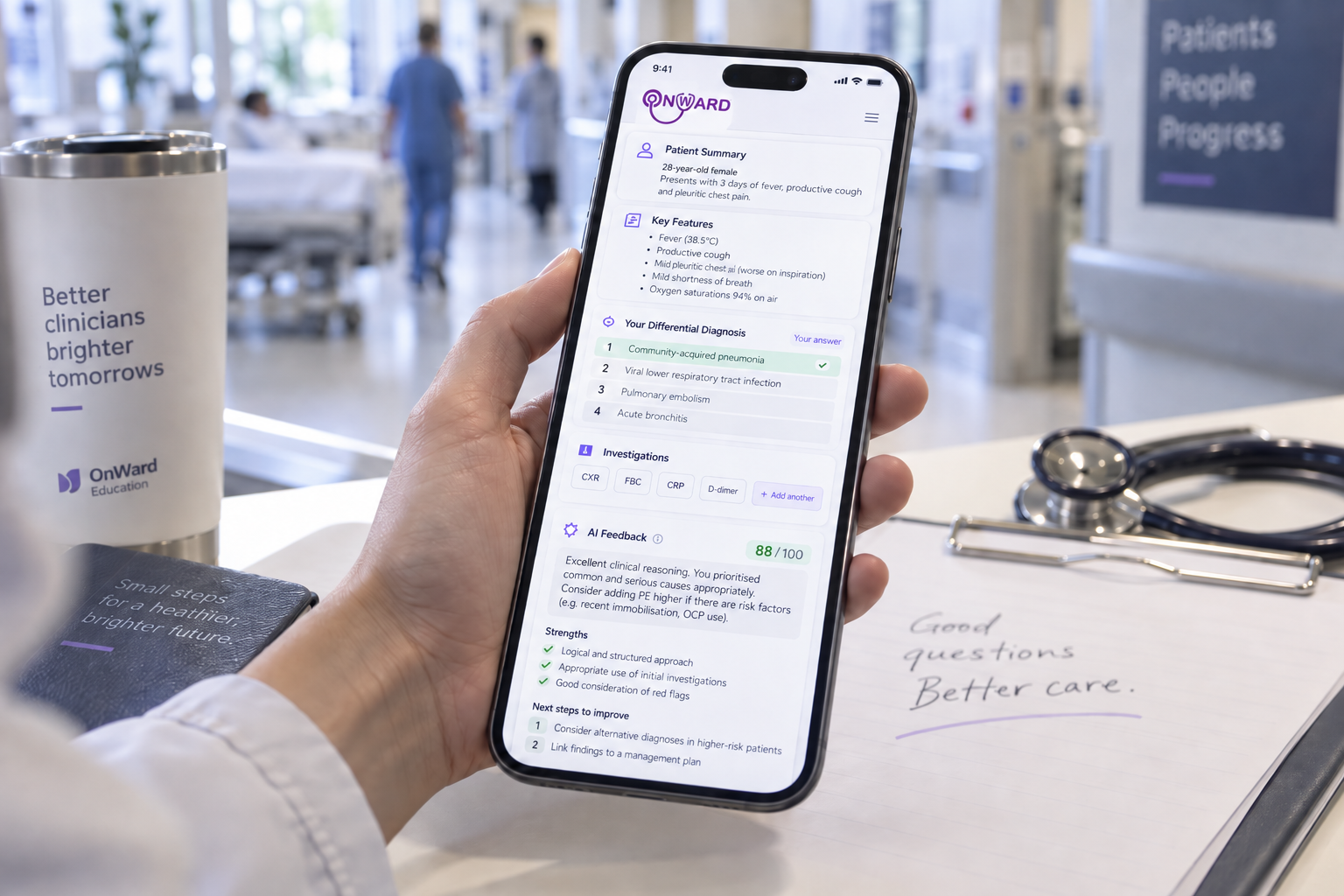
Students present a case through the app, working through history, investigations and management as they would on a round or in an exam, and get instant, structured feedback scored against a clinician-authored framework rather than a mark of right or wrong. The scoring criteria for each of the 100+ adult-medicine conditions in the case library were written by doctors and checked by a clinician before publication rather than generated by an AI. That is a deliberate design choice: a human stays in the loop on what counts as sound reasoning for a given case, so the feedback reflects how a real senior clinician would assess your differential, not an AI's approximation of one.
OnWard: AI-scored case presentation and reasoning practice, built for HSE wards OnWard Education was built by Dr Jake Robinson, a graduate of the Royal College of Surgeons in Ireland who has stood on HSE wards himself and seen how little space there is for structured feedback on a student's reasoning, not because nobody cares, but because nobody has the capacity. The platform gives students unlimited, low-stakes repetition in generating and defending a differential, then scores their reasoning against frameworks written by clinicians for the conditions that Irish medical students see on placement.
OnWard is not trying to replace the flashcard platforms or question banks already doing their job well. It occupies the gap next to them: the generation and defence of a live differential, the part of clinical reasoning that recognition-based tools were never built to practise. OnWard is backed by Enterprise Ireland and the Learnovate Centre at Trinity College Dublin.
Individual student access is €14.99 per month or €149.99 per year. Medical school cohort licensing is available on request.
What does the evidence support?
Deliberate, structured practice reliably improves clinical reasoning performance. That part of the research is settled. What is still developing is exactly how much AI-mediated practice adds on top of traditional bedside teaching, since the evidence base for AI-scored reasoning tools or Intelligent Tutoring Systems specifically is newer and smaller than the decades of research behind dual-process theory and illness scripts. Treat AI-scored practice as a plausible, evidence-supported way to get the repetition ward rounds cannot reliably give you, not as a proven substitute for bedside teaching or real clinical experience. No scoring tool replaces the pattern recognition that comes from seeing real patients under qualified supervision.
How should you practise to improve?
Commit to your differential before you see any feedback. Say it, write it or type it out loud before checking an app, a textbook or a registrar's answer. List out your rationale for thinking it. Reading the answer first defeats the exercise.
Use fictional or fully de-identified cases for any AI practice. Exclude the identifying information entirely, rather than lightly changing a few details, before you practise a real encounter with any AI tool. Your GDPR and HSE data obligations apply from day one of placement, and a data breach through a practice app carries the same consequences as any other. Our guide to AI ethics in medical education covers this in more depth, including what regulators and RCSI's own policy say.
Treat a miss as information, not a failure. When your differential is wrong, work out why: a knowledge gap, a bias such as anchoring on the first diagnosis you considered, or a finding you did not know to look for. That diagnosis of your reasoning is where the actual improvement happens.
Practise regularly, not just before finals. Illness scripts build with volume over time. Cramming reasoning practice into exam week gives you recognition for the exam, not the generative skill of a ward round or internship test.
Key takeaways
Clinical reasoning is the skill of generating and defending a differential, not of recognising the right answer among the options a paper has already given you.
Ward reasoning and exam reasoning draw on related but distinct skills. Both matter, and most resources for clinical students cover the exam skill far more than the ward one.
Structured, repeated practice with feedback on where your logic broke is what builds clinical reasoning, and that repetition is exactly what a two-minute ward round struggles to provide.
AI-scored feedback is a plausible way to get that repetition at volume. It complements question banks and flashcards rather than replacing them.
Never input real patient information into any AI tool. Use fictional or fully de-identified cases, with identifying information excluded rather than lightly altered.
Frequently asked questions
What is clinical reasoning in medicine? Clinical reasoning is the process of turning a patient's history, examination and results into a working diagnosis and management plan, then defending that reasoning when questioned. It combines a rapid, pattern-recognition route built on stored illness scripts with a slower, analytical route where a hypothesis is generated and tested.
How can medical students improve clinical reasoning skills? Medical students can strengthen their clinical reasoning skills by generating a differential before checking the answer, obtaining structured feedback on where their logic broke down rather than just whether the answer was correct, repeating the process often enough to build illness scripts, and reflecting on missed cases to identify whether the errors stemmed from a knowledge gap or a cognitive bias.
Does AI-scored feedback improve clinical reasoning? Structured, deliberate practice reliably improves clinical reasoning performance, and that evidence base is well established. Exactly how much AI-mediated practice adds on top of traditional bedside teaching is still a developing area of research, so it is best treated as a plausible, evidence-supported aid rather than a proven replacement for bedside teaching.
What is the difference between OSCE or exam preparation and clinical reasoning practice? Exam preparation, including single best answer questions and OSCE stations, generally tests recognition among options a paper has already generated for you. Clinical reasoning practice on the wards asks you to generate the options yourself from an open patient presentation and defend that reasoning under questioning, which is a related but distinct skill.
Is AI-scored practice a replacement for question banks like Anki? No. Question banks and adaptive flashcards are built for recall and recognition, and they do that well. AI-scored case practice targets a different gap: the generation and defence of a live differential, which is the part of reasoning that recognition-based tools do not practise.