

Last reviewed: October 2026 · 8 min read
Knowing the acronym is not the same as using it
Most students can recite SOCRATES by the end of the second year. Site, Onset, Character, Radiation, Associations, Timing, Exacerbating and Relieving Factors, and Severity.
SOCRATES' history taking is one of the first frameworks taught in medical school and one of the few that stays useful from a communication skills session right through to the wards.
At the bedside, SOCRATES works the way it was designed to work: it stops you from forgetting to ask whether the pain radiates anywhere or what the patient was doing when it started. That second task is the one that is hardest. Most students know SOCRATES as a set of questions to ask. The real skill is interpreting this information, synthesising a differential and being able to present it to a registrar or consultant under pressure.
The gap matters more than it looks. The history is where most of the diagnostic work is done. In a well-known study of medical outpatients, a diagnosis matching the one finally accepted was reached in 66 of 80 new patients after the referral letter and history alone, before any examination or investigation. The physical examination changed the picture in seven, and the laboratory investigations in a further seven. Worth being precise about that study, since it is often quoted loosely: the referral letter was part of the input, not the history in isolation. The conclusion still holds. If your history is thin, or if a good history gets lost in the telling, everything downstream is working with less than it should be.
What SOCRATES stands for
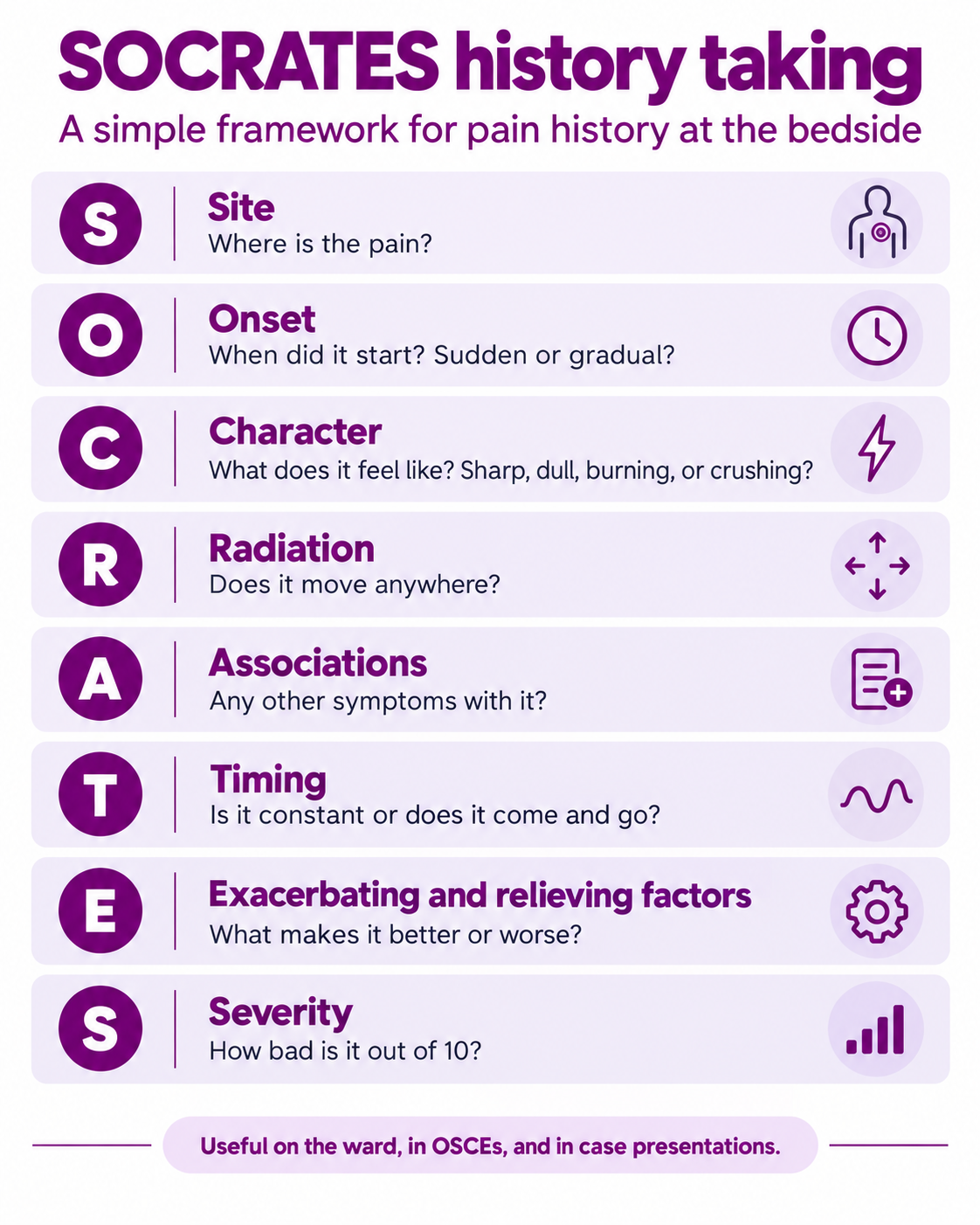
SOCRATES gives you a structure for exploring a presenting symptom so that nothing obvious gets missed. It’s taught across UK and Irish medical schools and used widely in clinical practice, including as a standard framework for assessing a patient in pain.
| Letter | What you ask | What the answer gives you |
|---|---|---|
| S – Site | Where exactly is it? Can you point to it? | Anatomical localisation, and whether the patient can localise at all. |
| O – Onset | When did it start? Sudden or gradual? What were you doing? | Is this an acute event or something more gradual? How long ago did it start? Were there any triggers? |
| C – Character | What does it feel like? | Type of pain: sharp, dull, achy, crushing or burning. Often, the single most discriminating answer can help differentiate the cause. For example, neuropathic pain might be electrical or stinging in nature. |
| R – Radiation | Does it move anywhere else? | Referred patterns, such as the jaw, arm, back or shoulder tip, can suggest underlying causes. For example, myocardial infarction (MI) might radiate to the left shoulder or jaw. |
| A – Associations | Anything else happening alongside it? | Nausea, sweating, breathlessness and fever. Note associated positive and negative symptoms. |
| T – Timing | Constant or does it come and go? How long each time? | Pattern over hours and days, whether it is progressing, and any diurnal variation. |
| E – Exacerbating and relieving factors | Does anything make it better or worse? | Positional, pleuritic, exertional or food-related triggers. |
| S – Severity | Out of ten, how bad is it at its worst? | Grades the severity of the pain and helps guide subsequent analgesic prescribing. |
Asking it and presenting it are two different jobs
Here is the part that trips up more students than the acronym ever does. SOCRATES is an input framework. It is not an output format.
When you present, nobody wants to see eight labelled headings. A registrar wants the story in the order a clinician thinks: what the symptom is, when it started, what it feels like, what came with it, and what it does over time. The letters should disappear into prose. If your listener can hear the acronym, you’re presenting the framework rather than the patient.
The common failures are consistent, and they’re all delivery failures rather than knowledge failures:
Not being able to discern the key details - A strong student will prioritise and note the key facts of a case, they know which details are important and lead with them.
Reading the letters out in order, including the empty ones. Saying “no radiation, no associations, no exacerbating factors” in sequence tells your team you worked through a list. Fold meaningful negatives into the story and drop the rest.
Giving severity without context. “Eight out of ten” means little on its own. “Eight out of ten at worst, down to four after the GTN” is a clinical finding.
Narrating the interview instead of the history. “I asked him about the onset and he said...” doubles your word count and moves the focus from the patient to you.
Losing the thread when interrupted. A consultant cutting in at “radiation” to ask about risk factors is normal. Getting back to where you were is a skill that only comes from repetition.
None of this is complicated to understand. All of it is difficult to do well at first, because it needs practice out loud rather than on paper. If you want the structure that sits around the history, our guide to presenting a patient case covers the full ward presentation, and building clinical reasoning skills covers defending the differential you arrive at once the history is delivered.
A worked example: chest pain, said out loud
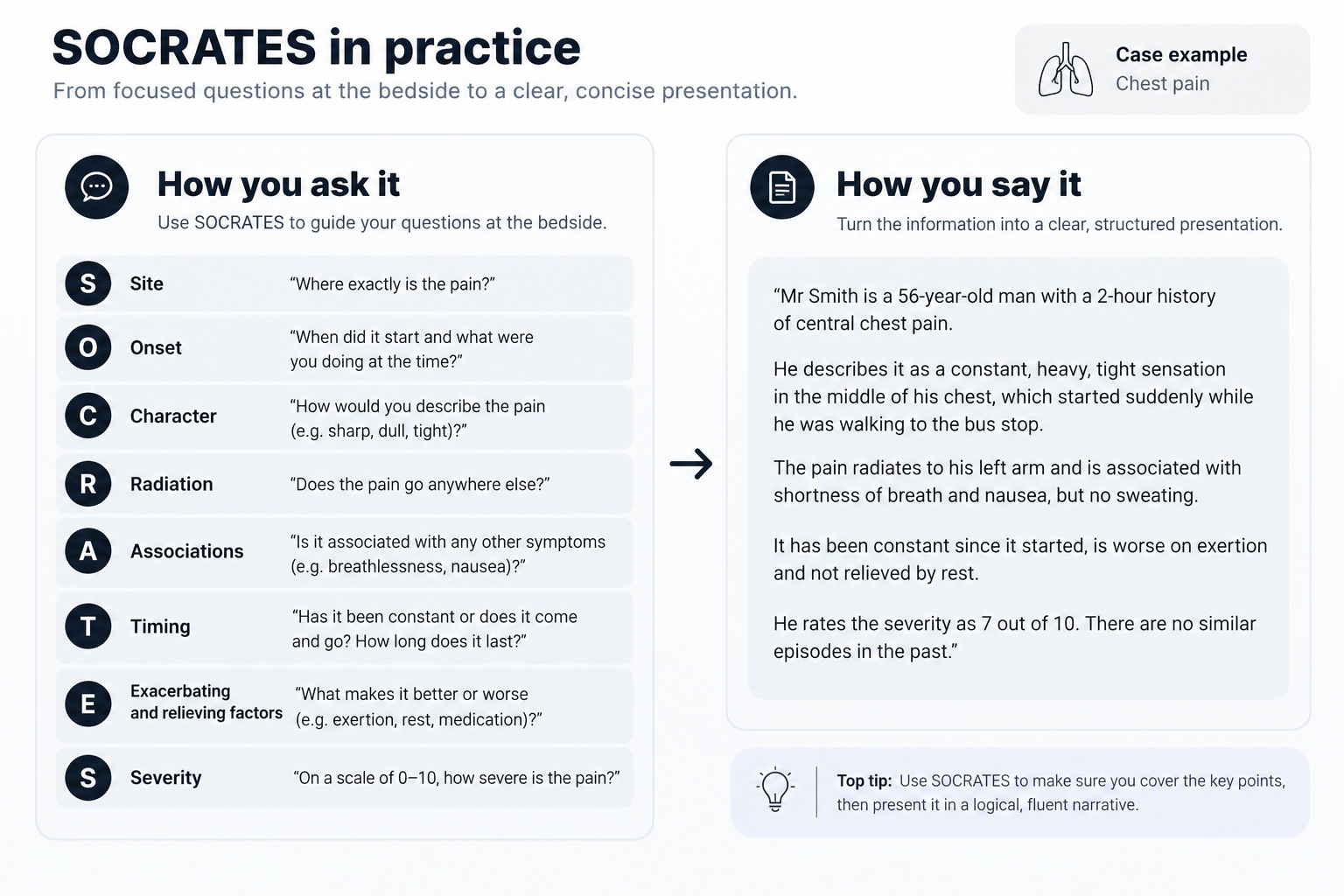
Here is a full SOCRATES history taking segment as it would be spoken on a ward round. The patient is fictional. Every letter is present, and none of them is announced.
“This is a 58 year old man admitted overnight with central chest pain. It came on suddenly while he was watching television last night. He describes a heaviness in the centre of his chest that spreads to his left arm and up into his jaw. There was associated nausea, and sweating came with it. It's been constant since it started, and it isn't affected by position or deep breathing or palpation. He said it was eight out of ten, at its worst, coming down to around four after GTN in the ambulance. He has a history of low levels of control and has smoked fifteen cigarettes a day for years.
That takes about thirty seconds to say. All eight elements are in it. The discriminating features, character and radiation, land in the second sentence rather than the last. The two negatives included are the ones that matter diagnostically, because they argue against pleuritic and musculoskeletal causes, and the dozen negatives that don’t change anything have been left out.
Say that version out loud once and compare it to how you’d deliver the same information cold. The difference between the two is almost entirely practice.
OnWard: structured feedback on the histories you present
OnWard is built around that practice gap. Students record an oral case presentation based on a real patient encounter with identifying information excluded and get AI-scored feedback on the structure and reasoning markers that matter on a round: how clearly the opening line lands, whether the history included is relevant, how well the impression is stated, and how the differential is defended. A human reviews how the tool is scoring, so the feedback stays grounded in clinical judgement rather than a fixed checklist.
As Dr Jake Robinson put it when a medical student raised the same problem on LinkedIn:
“Our aim was to use AI to empower students to make more of every clinical interaction by getting structured feedback on their case presentations and history taking, even when a consultant isn’t available to teach in that moment.”
This doesn’t replace a registrar’s teaching. It fills the space between ward rounds, where most students currently get no signal at all.
How to practise so it holds under pressure
Say it out loud before the round, not in your head. Silent rehearsal hides the sentences that don’t flow when spoken.
Time yourself to thirty seconds for the history segment. If you run long, the cut comes from the negatives.
Rewrite your clerking into spoken prose. Take a written history you’ve already taken and convert it into something you’d say. That conversion is the skill.
Practise being interrupted. Ask a peer to interrupt you at a random point, then continue from where you were.
Use real encounters, handled properly. Practise on patients you’ve genuinely seen, with identifying information excluded. Our guide to the ethics of AI in medical education covers what that means in practice under GDPR and HSE obligations.
What SOCRATES is really for
SOCRATES earns its place twice in a clinical encounter, and students usually only train for the first. At the bedside, it acts as a safety net, ensuring you don’t miss the question that could change your differential. On the round, the information it gathered must be delivered in a form that a stretched clinician can use in under two minutes. The first use is a checklist. The second is a performance, and performances improve with repetition and specific feedback, not by re-reading the acronym.
Key takeaways
SOCRATES is an input framework for gathering a history, not an output format for presenting one. If your listener can hear the letters, you’re presenting the structure instead of the patient.
Character and radiation usually carry the most diagnostic weight, so they belong early in the spoken history rather than in sequence positions three and four.
Include only the negatives that change your differential. Reciting the empty letters signals list work, not clinical thinking.
A complete SOCRATES history segment should take around thirty seconds to deliver on a ward round.
The history carries most of the diagnostic load, which makes how well it’s communicated a clinical issue, not a presentational one.
Frequently asked questions
What does SOCRATES stand for in history taking? SOCRATES stands for Site, Onset, Character, Radiation, Associations, Timing, Exacerbating and relieving factors, and Severity. It gives you a structure for exploring a presenting symptom so that the questions most likely to change your differential get asked.
Is SOCRATES only used for pain? Yes. SOCRATES is primarily designed for pain assessment and is best used to explore the characteristics of a patient's pain, including its site, onset, character, radiation, associated symptoms, timing, exacerbating or relieving factors, and severity. While some elements may help when assessing other symptoms, it is best suited to pain history.
What is the difference between SOCRATES and OLD CARTS? They cover much the same ground with different letters. OLD CARTS stands for Onset, Location, Duration, Character, Aggravating Factors, Relieving Factors, Timing, and Severity. Which one you use matters far less than using one consistently, so follow whichever your medical school teaches.
Do I need to ask every letter of SOCRATES every time? Ask every letter that could plausibly apply, then present only what’s relevant. Asking widely and reporting selectively is what separates a thorough history from a long one.
How should I present a SOCRATES history on a ward round? Present it as prose in roughly thirty seconds, without naming the letters. Lead with age, presenting complaint and onset, then character and radiation, then associated features, timing and severity, folding in only the negatives that affect your differential. This is a guideline that can be adjusted depending on clinical findings.
Ready to practise delivering a history and hear exactly how it lands? Explore Our Subscriptions, or read answers to common questions first, or get in touch if you teach on clinical placements and want to hear about the Educator Portal.