
Best Medical Education Apps for Students in 2026
By OnWard Education · Last reviewed: August 2026 · 10 min read
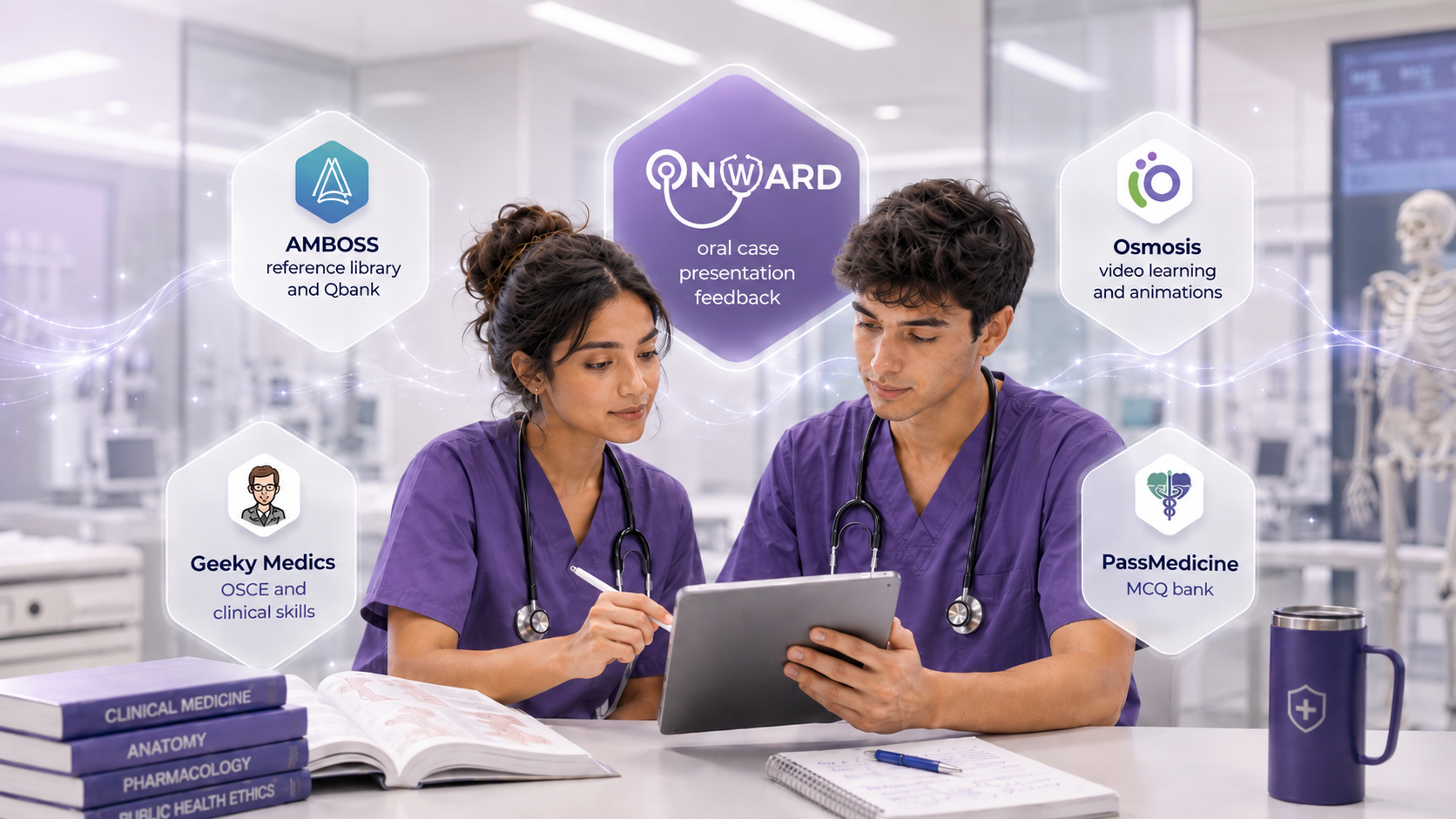
The apps for medical students actually worth knowing about in 2026 are OnWard, AMBOSS, Geeky Medics, Osmosis, and InSimu. Five is enough to cover the jobs a clinical student genuinely needs done: oral case presentation practice, written board revision, OSCE station drilling, foundational video learning, and MCQ prep. None of the five does all five jobs, and any roundup of medical student apps that claims one does everything is likely trying to sell you their app!
That matters more in medicine education than in most other categories covered by a “best apps” list. A student choosing the wrong note taking app wastes a subscription. Relying on the wrong tool to prepare for a ward round, an OSCE station, or a written final puts a student at risk of jeopardising their college grades and potentially any residency or training scheme applications. So this list is built around a specific question for each app: what job is it actually built for, and does that job match the gap you have right now? Here's what each one does, what it costs, and where it genuinely falls short, so you can pick the two or three that cover your specific gaps instead of just guessing and hoping one app covers everything.
How we picked
We applied five criteria consistently to every app on this list, including ours.
These apps are built for medical students in clinical training, not generic study apps with medical content as an afterthought. There are broad exam prep platforms that serve dozens of professional fields; this list only covers tools built around the specific demands of clinical medical education.
Actively maintained, with a working product, an app store listing that's still being updated, and a real, current pricing page rather than a directory listing that hasn't changed in years.
Pricing and features checked directly against each provider's own site in August 2026, not pulled from an old review, a forum thread, or a competitor's marketing copy about them. Where a provider runs rotating promotional pricing rather than one stable figure, that's stated directly instead of quoting a number from a sale that might already be over.
Each app is judged against the specific job it is designed to do. The key question is whether it supports oral case presentation and ward-based clinical reasoning, which is the gap this analysis examines from OnWard’s perspective, or whether it serves a different purpose entirely, such as board exam recall, OSCE preparation, or foundational video-based learning.
Apps that perform a different job well are not marked down for failing to address OnWard’s specific use case. This distinction is applied consistently throughout every section below.
Disclosure: This article is published on onward-education.com and includes OnWard in the comparison. It is written by OnWard’s own content team, so readers should take that context into account when weighing the conclusions.
We have aimed to make the comparison as transparent and evidence-based as possible. Every pricing and feature claim was checked directly against each provider’s own website, and we have described the genuine limitations of each product as clearly as its strengths, including OnWard’s own. Pricing was verified as of August 2026 but may change, so readers should confirm current pricing directly with each provider before making a decision.
We do not claim complete neutrality. As a company operating in this market, OnWard has its own perspective on the problems medical education tools should solve. We believe stating that openly is more useful than presenting the comparison as entirely independent.
OnWard
Best for: getting scored feedback on oral case presentations during actual ward placements, the one job none of the other four apps on this list are built to do.
OnWard is built around a specific moment in clinical training: a student sees a patient on the ward, takes a history and examination, and then needs to turn that encounter into a structured clinical case presentation. Using OnWard, they can present the case and receive structured AI-assisted feedback on how well they identified, organised and communicated the relevant clinical information.
Case presentations are assessed against clinician-authored frameworks covering more than 100 common adult medicine conditions. These are built specifically around NHS and HSE ward practice, rather than adapted from a US curriculum or exam resource. The educational content is written by doctors, not generated by AI, with AI used to assess the student’s presentation against that predefined framework.
Each case is automatically recorded in a digital logbook, reducing the need for separate documentation after placements. OnWard Insights then tracks engagement, clinical exposure and performance by speciality over time.
The workflow is simple: see a patient, present the case, receive feedback, log the encounter and build a longitudinal record of clinical experience. The aim is to help students get more value from the patients they already see, especially when they receive limited regular senior feedback.
OnWard costs €14.99 per month or €149.99 per year, making it the lower-priced app on the market.
What it doesn’t do: OnWard is not a general medical-school study platform. It does not currently offer large written question banks, simulated OSCE stations or video lectures. Its focus is narrower: ward-based clinical reasoning, oral case presentation, feedback and clinical case logging.
Explore OnWard's clinical case presentation tools →
AMBOSS
Best for: revising for written finals and licensing exams with a large, trusted question bank and reference library.
AMBOSS is the exam-revision standard among medical student apps for a reason. Its Qbank and medical library contain roughly 13,900 questions and 1,270 library articles, covering the breadth of written medical knowledge that most UK and Irish schools examine. A newer AI Mode Learning copilot turns a student's own question history and notes into spaced-repetition flashcards, and AMBOSS also offers institutional reporting tools schools can use to track cohort performance. Pricing, checked live against amboss.com in August 2026, is $19.99 a month when billed monthly or $12.50 a month when billed annually.
Written boards against the ward round are the honest way to frame AMBOSS against OnWard. AMBOSS doesn't touch oral case presentation at all: a student can be excellent on AMBOSS's question bank, know the pharmacology and the differentials cold, and still walk into a ward round with no structured feedback on how they actually present a patient out loud under time pressure. That's not a knock on AMBOSS. Written knowledge and verbal, real-time presentation are different skills, and AMBOSS was never built to test the second one. Most students in their clinical years end up needing both tools rather than choosing between them: AMBOSS is for the knowledge base that a written exam actually tests, while something like Onwards is for the verbal, structured-feedback skill that a written exam doesn't touch at all.
Geeky Medics
Best for: OSCE station practice and clinical skills drilling, with the largest free tier of any app on this list.
Geeky Medics has built a genuinely large OSCE and clinical-skills library: roughly 200 examination guides, 5,000 practice questions, and 3,000+ flashcards, plus an AI virtual-patient feature (800+ virtual patients that give examiner-style feedback on history taking). The free plan is real rather than a crippled trial, so a student can get genuine value before paying anything, which matters given how many other costs stack up across the clinical years. Premium bundles start from £69.99 a year, as checked live against geekymedics.com in August 2026.
The honest framing against OnWard is an OSCE station rehearsal against a real ward-patient presentation. A simulated OSCE history-taking station and presenting an actual patient you've just clerked on a ward round draw on related skills, structured history-taking and clear communication, but they are not the same skill. An OSCE station is scripted, time-boxed, and examiner-assessed against a fixed mark scheme. A ward presentation is live, unscripted, and judged by whoever happens to be on the round that day. Geeky Medics is built for the former at real depth, and it's excellent at it. It doesn't cover the latter at all, which is precisely the space OnWard occupies and Geeky Medics doesn't compete for.
Osmosis
Best for: building or refreshing foundational knowledge through video before you're relying on it at the bedside.
Osmosis's real strength is format: a large library of video explanations, roughly 1,700 videos and 2,700 associated questions, across a wide range of topics, plus a newer “Osmosis AI” chat feature layered on top of the video content. It has real institutional reach through school partnerships, which matters if a student's own curriculum already points them toward it. Pricing runs across multiple subscription tiers with frequent promotional pricing rather than one flat monthly figure, so the current rate is worth checking directly on osmosis.org/plans before treating any single number as fixed.
Passive video learning against active scored practice is the real distinction from OnWard. Watching a video explanation of a condition is a genuinely useful first pass, but it doesn't train the specific, active skill of presenting a patient with that condition out loud, under time pressure, to someone judging the reasoning as it's spoken. Osmosis builds the knowledge; it isn't built to test whether that knowledge holds up once a student has to perform it live in front of a registrar.
One more worth knowing: PassMedicine
Best for: high-volume written exam preparation, particularly medical finals and the UKMLA.
PassMedicine is one of the strongest value options for traditional exam revision. Its Medical Student Finals/UKMLA package includes more than 12,000 single-best-answer questions, a high-yield textbook, performance analytics, and additional OSCE and Prescribing Safety Assessment resources.
Its main strength is volume. Students can work through large numbers of syllabus-focused questions, review detailed explanations and revision notes, create timed tests, and compare their performance with other candidates. This makes it particularly useful for consolidating knowledge and preparing for written examinations, rather than for practising ward-based clinical reasoning.
It is also exceptionally inexpensive. The Finals/UKMLA package costs £15 for four months, £20 for six months, £25 for nine months or £30 for twelve months. PassMedicine also offers its Years 1–3 resource free for 12 months.
Where it differs from OnWard is the job it is designed to do. PassMedicine primarily helps students prepare for exams through question-based recall and knowledge consolidation. It is not designed around seeing a patient on the ward, presenting that case, receiving feedback on the presentation and automatically building a clinical logbook. For written exam preparation, PassMedicine is difficult to beat on breadth and price; for ward-based case presentation and longitudinal clinical learning, it serves a different purpose.
Quick comparison table
Five medical student apps, one job each, lined up side by side rather than spread across four separate pages:
| App | Built for | Price (Aug 2026) | Best for |
|---|---|---|---|
| OnWard | Oral case presentation scoring on real ward patients | €14.99/mo or €149.99/yr | Ward-round feedback, NHS and HSE specific |
| AMBOSS | Written exam and board revision | $19.99/mo, or $12.50/mo billed yearly | Finals and licensing exam prep |
| Geeky Medics | OSCE station and clinical skills practice | Free plan; premium from £69.99/yr | OSCE drilling on a budget |
| Osmosis | Video-based foundation learning | Multiple tiers; see osmosis.org/plans | Building knowledge before placements |
| PassMedicine | MCQ Question Bank | Multiple tiers, £30/yr | Written exam preparation |
Figures marked are carried from the T.O.P. Master Document's competitor research and refreshed against each provider's live site in August 2026; pricing for all five was checked live in August 2026 and isn't flagged.
What running two apps actually costs
Since most students end up pairing two of these rather than picking one, it's worth knowing what that actually costs before committing. Pairing OnWard with Geeky Medics' free tier costs no more than OnWard alone, €14.99 a month, since Geeky Medics' free plan is genuinely free. Pairing OnWard with InSimu's free tier is the same story; InSimu's premium plans only start to matter if the free case bank stops being enough. OnWard alongside AMBOSS is the priciest realistic pairing among these medical student apps: roughly €14.99 a month plus AMBOSS's $12.50 to $19.99 a month depending on billing cycle. These are two separate currencies, so budget for both figures rather than expecting one combined number, and check the exchange rate on the day you subscribe rather than assuming a fixed conversion. Osmosis is the hardest to budget for precisely, since its promotional tiers shift, so check the live rate before assuming a figure. None of these options is an argument for subscribing to everything at once. It's a reason to pick the specific pairing that covers your actual gaps, exam knowledge plus ward feedback, or OSCE drilling plus ward feedback, rather than defaulting to whichever app a friend happens to be using.
Which one should you actually use
Choose OnWard if you want to maximise your clinical placements by learning directly from the patients you see. It turns everyday patient encounters into structured opportunities for case presentation, feedback and reflection in a way none of the other apps on this list are designed to do.
Choose AMBOSS if written finals or licensing exams are your immediate pressure and you want a trusted, large question bank and reference library to revise with. It's the most expensive of the five, which is easier to justify if it's genuinely your main revision tool through most of medical school rather than a casual add-on.
Choose Geeky Medics if OSCEs are the near-term concern and you want high-volume station practice, especially if the budget is tight. The free tier alone covers a lot of material, so you can try it out to see if it suits your revision style before paying for anything.
Choose Osmosis if you learn best from video and want broad foundational coverage before you're deep into clinical placements, or as a refresher for topics you haven't touched since pre-clinical years.
Choose PassMedicine if you want high-volume written exam preparation, particularly for medical finals or the UKMLA. It is one of the cheapest options here and works best for students who prioritise question-based recall, syllabus coverage and exam practice over ward-based clinical presentation.
Realistically, most students in their clinical years end up running two of these apps, not one: a knowledge-base tool, AMBOSS or Osmosis, alongside a skills-practice tool, OnWard,
Frequently asked questions
Is this list biased since OnWard wrote it?
It's a fair question to ask of any vendor-written roundup of apps for medical students. OnWard's content team wrote this one, as disclosed above, rather than left it implicit. What that doesn't change is the substance: every price and feature claim here is checked against each provider's own current site, every app's genuine limitations are stated as directly as its strengths, and three of the five entries actively point a reader toward a competitor for specific uses. OnWard doesn't do it all. Please read the reasoning in each section and judge it on that basis, rather than treating the disclosure alone as proof either way.
Can I use more than one of these apps at once?
Yes, and most clinical students already do, whether or not they consider it to be a deliberate strategy. These five apps are built for different jobs, not competing for the same one, so running a knowledge-base app for exam content alongside a skills-practice app for OSCEs or ward presentations is the normal pattern among students juggling multiple pressures at once, not a sign of picking inefficiently.
Do any of these replace supervised clinical teaching?
No, and none of the five claims otherwise. All five are practice and revision tools that sit alongside, not instead of, supervised placements, official curricula, and clinical guidelines from bodies like the GMC and the Irish Medical Council. A ward round teaches things no app reproduces: reading a room, managing uncertainty at a bedside, and absorbing a senior clinician's instinct in real time. Every app on this list is a supplement to that, not a substitute for it.
OnWard Education is a MedEdTech company founded by Dr Jake Robinson, a graduate of the Royal College of Surgeons in Ireland. OnWard's app gives medical students AI-scored feedback on oral case presentations during clinical placements.
Do any of these apps offer a free trial before you commit?
Geeky Medics is the clearest yes: its free plan is a genuine working tier, not a time-limited trial, so you can use a meaningful portion of the content without ever entering a card number. PassMedicine offers its Years 1–3 resource free for 12 months, which is a substantial commitment for pre-clinical students. AMBOSS runs a time-limited free trial on sign-up, though the length and terms are worth checking directly on their site since these can change. Osmosis varies by tier and institution, so the best route is to check osmosis.org/plans for whatever is currently available. OnWard does not currently offer a free tier. The subscription starts at €14.99 per month, and the full feature set is available from day one of a paid plan.